


FlashForward's tense Mark/Lloyd/Olivia love triangle will come to a head on the Oct. 22 episode when third-wheel Lloyd (Jack Davenport) knocks on the door of married couple Mark (Joseph Fiennes) and Olivia (Sonja Walker), who saw a future glimpse of herself and Lloyd together as a couple.
“Mark’s not pleased to see Lloyd,” teases Jack, whose character arrives with the autistic son (Dylan) Olivia has been treating at the hospital. From his own flash forward, Dylan will immediately recognize both the house and Mark and Olivia’s daughter, and feels an instant connection.
“It’s a weird territory,” adds Joseph. “Lloyd and Mark can’t condemn each other at this stage for what hasn’t yet happened. Plus, you risk possibly manifesting the (infidelity) outcome as a self-fulfilling prophecy.”
Source: TV Guide Magazine
Showing posts with label Media Mentions. Show all posts
Showing posts with label Media Mentions. Show all posts

Now that everyone has had time to catch up on the latest episode of ABC's FlashForward and debate what they saw, we figure it's time to take a closer look at the ending in Somalia where ... something .... appeared in the sky.
The scene takes place in an area where a whole bunch of people suffered a blackout similar to the flash-forward, but this one happened back in 1991. A small shepherd boy watches a bunch of flying crows suddenly die and plummet to the ground, crests a hill, and sees bodies all over the ground, followed by something with the appearance of a cloud that looks sort of maybe like a ship.
To figure out what it might be, we eavesdropped on the fan debate over on ABC's site and have pulled together the list of possibilities so far:
Some kind of ship: The cloud is a ship, human or otherwise. Or it's the trail from a ship. This alleged ship emitted something or dropped some kind of bomb or otherwise did something that killed that crows. It may even be a Nazi ship, since the whole episode dealt with that cagey old Nazi in prison. Although these are all interesting theories, consensus from the audience is that the cloud isn't a ship, mostly because that would seem too obvious.
A nuclear explosion: The cloud came from a nuclear, or nuclear-like, explosion. True, some kind of explosive something-or-other (or emissions from an explosion ... see EMP below) may well have caused the crows to die in Somalia, but we also know crows later die around the world, and no explosions are reported. This one seems unlikely too.
An EMP pulse or solar flare: These theories come up regularly but are shot down pretty quickly, since theywere ruled out by the characters themselves in the pilot. We guess it's still possible, and the first episode was throwing out a bit of misdirection, but it's not very dramatic or satisfying.
Discharge from the tower: The cloud-ship-thing is seen hovering over a strange tower, but could it have actually come from the tower? The theory here is that there may be some sort of plant or hidden complex underground housing ... er, something ... that caused the crows to die and the people to pass out. Or that the tower itself is emitting waves of something. Consensus seems to be the tower was just in the shot to give perspective, though.It's a Higgs boson: In case you didn't know (we had to look it up), a Higgs boson is "a massive scalar elementary particle predicted to exist by the Standard Model in particle physics." Assuming the particle could be the size and shape of a cloud (doubtful!), this would certainly tie in to Rob Sawyer's book Flashforward, on which the show is based. No one lends this theory much credence, though, because the show seems to be taking pains not to repeat what happened in the book.
The inevitable Lost comparison: It's been noted by many that this "cloud" could be smoke, which is eerily similar to Lost's "smoke monster." Deliberate? Probably. Meaningful? Doubtful. There was no clankity-clank sound, after all.
The cloud is shaped like a crow: There is no actual theory here, but some viewers have noted that the cloud is vaguely shaped like a crow and a lot of crows die. We're including it just so we don't look foolish if there really is something to it.
Cloaked Goa'uld Death Glider: The cloud does bear a passing resemblance to the Goa'uld fighters from Stargate SG-1, but unless Richard Dean Anderson shows up as a guest star, we're going to have to say no.
Our best guess: None of the above. The cloud will almost surely turn out to be some kind of red herring, like most of the "clues" we've gotten so far. Or it's a nuclear crow ship that activates the tower, which in turn creates a Higgs boson solar flare on the island from Lost, where MacGyver is living in retirement.SOURCE: SciFiWire

E! online has confirmed that this season will be 24 episodes long.

The FlashForward event that shook the world goes from global to mobile with Flash Ahead sponsored by Sprint. Go beyond the blackout to access bonus features that may include videos, photos or text messages.
Mark Benford isn't the only one trying to piece together a complex puzzle. Now FlashForward fans can take matters into their own hands as they explore and investigate this worldwide phenomenon.
Here's how it works:
A keyword will appear briefly within the trailer that runs during the end credits of each episode. Sprint customers text the keyword to 22288 to access the bonus content.
Look for a keyword each week beginning with the FlashForward premiere on September 24, 2009 and continuing throughout the fall. Anyone who misses the keyword during the Thursday airings can head over to ABC.com on Fridays to see the weekly keyword.
All keywords will be posted on this page in the order that they are revealed on-air. Unscramble the keywords and you may uncover a sentence that adds a surprising twist to the mystery!
Source: ABC
It’s a lot like the beginning of “Lost,” is it not? Guy wakes up confused and gradually discovers and deals with the cinematic mayhem has risen up around him. There’s even a difficult-to-explain kangaroo subbing for the “Lost” pilot’s polar bear.
So that first part with the wreckage and the corpses? Well-copied.
But the “FlashForward” pilot was adapted not by super-successful writer-director J.J. Abrams, but by Brannon Braga (creator of “Star Trek: Enterprise”) and David Goyer (writer-director of “Blade Trinity”), who previously created CBS’ “Threshold.” Which was not remotely as good or as successful as “Lost.”
Once the mayhem is dealt with viewers may start to notice two other major things that distinguish “FastForward” from “Lost”:
1) Everybody on screen is catching on to what’s going on a lot more slowly than the audience is. Which gets boring. And annoying.
2) None of the show’s many characters (or their flashforwards) is terribly interesting or engaging. At the end of the “Lost” pilot you were dying to know not only what was going on with Smokezilla and that bizarre French radio signal but also what the deal was with handcuffed Kate and evasive Charlie and the vaguely sinister Locke. Even less mysterious characters like Shannon and Hurley were so entertaining in their own ways that viewers were excited at the prospect of spending more time with them as well.
Less problematic for “FlashForward” is the fact that the “Threshold” series creators apparently took a couple liberties with the the sci-fi novel by Robert J. Sawyer
, in which, thanks to a super-high-energy experiment gone wrong, everyone in the world passes out and experiences two minutes and 17 seconds of his or her own life 21 years in the future.
The TV version of the premise, maybe slightly less brimming with potential, puts the flashforwards only several months ahead, and nobody knows what caused them. In the final minute of the pilot we are given a clue of sorts, and it makes for a great ending. If you’re impatient and don’t mind spoilers you can find how here.
The date everyone flashes forward to, April 29, 2010, is a Thursday, and a key new episode of “FlashForward” is currently slated to air on that date. If this series gets that far against “Survivor,” “SNL Thursday,” “Bones” and “Vampire Diaries,” that episode will likely NOT be the season finale, according to Goyer.
In the flashforward experienced by the Joe Fiennes FBI character, the Fiennes character is seen investigating the cause of the flashforward. But even though everyone learns the exact future date and time of the two-plus minutes their memories will capture, no one in the flashforwards makes an effort to surround themselves with useful ballscore tables and/or stock market charts. So apparently the flashforward event paradoxically changes the timing of -- or eliminates -- the big communal flashforward. Or something.
“Lost” vet Dominic Monaghan is not in the pilot but does turn up, I believe, as a superscientist in episode two. If you watched the clip above you may have recognized the doctor is embodied by Sonya Walger, who plays Penny Widmore on “Lost.”
Insufferable “Family Guy” mastermind Seth MacFarlane, who cameos in the pilot as an FBI man, is a horrible distraction. He uses for his “FlashForward” role the same obnoxious deejay voice he uses to play the dog in “Family Guy.” Let’s try to keep his particular brand of unfunny confined to Fox, shall we fellas?
I’m setting the DVR for episode two, but this pilot does not convince me “FlashForward” is season-passworthy.
… I wish more attention had been paid to fleshing out the characters and generally bringing a fresher voice to the dialogue. (Someday, I want someone to bring a cool high-concept like this to a producer like Jason Katims, who can play it out realistically through rounded characters, as he did on Roswell.) … Do I Want to Watch Another Episode? Absolutely. But please work on making these folks as appealing conscious as they are unconscious.
From its unsettling opening image to its startling final shot, FlashForward could be the best network movie you'll see this year. Now let's hope it's an equally good series. … may not keep you hooked for years or even months, but chances are good tonight's episode will bring you back next week.
… begins in such a spirit of bracing suspense that I am challenged to recall another pilot that lured me so quickly into addiction. … has the sobriety and charge of the best, early days of “24” but builds its tension more gracefully and feels reluctant to be get subsumed by its own philosophizing. And like “Battlestar Galactica,” its has a presumed message that is humanistic and uplifting: No single messiah can save us; it takes a village to save the world.
… a decent but not brilliant beginning. … Given the subject, it's almost appropriate how unusually difficult it is to get a fix on the show. The pilot is melodramatically eventful, though the dialogue can sound phony. But the show could go either way -- be kind of great or pretty awful, depending on what comes next, how the writers plan to explain this thing and whether we are going to have any fun on the way to the explanation. … we have seen a lot of doctors and FBI agents on TV -- four of the main characters work for the bureau -- and spent a lot of time on the streets of Los Angeles. We may need more than parlor tricks to take us out of that all-too-familiar world. My crystal ball remains cloudy on this matter.
… Elements that generally work in the two-hour pilot's favor -- a big budget, a flashy central concept and a handsome ensemble cast -- also work against it because those are the hallmarks of several ABC pilots that have crashed and burned in their debut seasons. … What "FlashFoward" lacks, at this point, is a Sawyer or a Hurley; don't look to this serious pilot for wisecracks or regular-Joe wisdom. …
… Immediately apparent from the premiere of "FlashForward": The questions may prove more satisfying than the answers, a bad sign. … "FlashForward," with lots of flash-cut editing (oddly offset with long, slow dialogue scenes) and some eye-pleasing special effects, seems a show very much of today and today's version of tomorrow and maybe even tomorrow's version of today. But if it were a little less ditzy and a little more clear-cut, it might stand a better chance of seeing tomorrow itself.
The San Francisco Chronicle says:
… enormously entertaining and there's mystery galore here, with an expansive cast, an unexplained phenomenon and the tantalizing premise … Here's hoping it stays strong and compelling as it heads to April 29.
The Pittsburgh Post-Gazette says:
… suspenseful, disaster-filled entertainment. But will what comes next be as entertaining? If only we could flash forward to find out. …
Ambitious but not terribly engaging … An interesting idea, but placed in the middle of a bland cast of characters (including Joseph Fiennes as an FBI agent and Sonya Walger as his doctor-wife) and execution that lacks much urgency. …
… Every season there seems to be one water-cooler show everyone ends up talking about. “FlashForward” is it: Get in on the first episode. …
… Tonight’s episode is dramatic and well-paced, unfolding ominously and quickly explaining the issues at hand. The problem, of course, is the future. What “Lost’’ had on its side was a desert-island setting, plus a sprawling and quirky ensemble cast with a range of back stories to spin. … “FlashForward’’ is a good idea, and while that’s no guarantee of a good series, the first hour gives us reason to hope.
… Strictly grading the pilot, it's an intriguing, mind-bending concept that's mostly well executed, with a built-in payoff cleverly timed to coincide with the May rating sweeps. The bottom line is after one hour, there's a solid desire to see more, but not such wonderment as to proclaim unwavering fealty until the show peers a little farther down the road. …
… The investigation of this consciousness-shattering global phenomenon is assumed by the Los Angeles bureau of the FBI, which is a little like giving Mr. Kotter's science class responsibility for checking out global warming. (In Sawyer's book, particle physicists tackled the issue, but when was the last time you saw one of those on TV?) … Well-cast and full of expensive-looking special effects, "FlashForward" should hook a respectable number of viewers with its combination of surprise and suspense. …
Source: Ain't It Cool News
If the world were to expire sometime before Friday, the debate between free will and determinism would trace its history from the Greeks, through the battles between Augustine and Pelagius, Erasmus and Luther, the writings of Hobbes, Hume and William James, ending effectively with the questions posed by big-budget American serial television. In the years since 9/11, producers have found rich thematic material in the arguments for and against preordination, resulting in series like “The Sarah Connor Chronicles,” “Lost” and now “FlashForward,” which begins in such a spirit of bracing suspense that I am challenged to recall another pilot that lured me so quickly into addiction.
Joseph Fiennes, Lennon Wynn, center, and Sonya Walger in a scene from “FlashForward,” based on a science fiction novel.
Loosely based on a clunky science-fiction novel of the same title by Robert J. Sawyer, “FlashForward” (starting Thursday on ABC) imagines a global blackout in human consciousness — lasting precisely 2 minutes 17 seconds — when billions of people around the world experience visions of their lives six months into the future. Specifically they’re seeing themselves on April 29, 2010. And while “FlashForward” seems to avoid (at least so far) the geeky pretensions of “Lost,” which invite so much circuitous decoding, the date hardly seems arbitrary as it carries the symbolic weight of historic incident.
It’s tempting to go down the rabbit hole; this is, after all, a post-“Lost” world and who could resist the temptation? April 29 is the day Joan of Arc, after receiving visions calling her to divine mission, relieved the siege of Orleans. It is also the anniversary of the riots over the Rodney King beating in Los Angeles, where “FlashForward” is set amid the mayhem, looting and fires that transpire in the immediate aftermath of the collective expulsion of memory. In one sly turn during the premiere, crowds stampede into the streets with Circuit City boxes, as if that bankrupt consumer electronics company hasn’t suffered enough.
Again, the reference seems almost purposeful. “FlashForward” is similarly a behemoth, a drama on network television, and yet one primed to exalt the hold of new media. The Web and its spirit of collectivism are immediately deployed to guide the F.B.I. agent Mark Benford, played by the appropriately moody Joseph Fiennes, through his efforts to unravel what happened. Benford and his colleagues quickly set up a Web site — Mosaic — to allow visitors to post details of their futuristic visions so that agents can analyze them and extract clues.
Like so many contemporary television thrillers, “FlashForward” works just as powerfully as a domestic drama as it does as a mechanism of apocalyptic intrigue. Benford is a recovering alcoholic, devoted father and husband of an attractive, hard-working doctor (given to us by Sonya Walger, Penelope on “Lost”) who has clearly tested her commitment in the past. During their lapses in consciousness, each is privy to unsettling images of their relationship half a year hence, and the question remains (as it does for all the characters in the ensemble cast) whether the outcome is fated or subject to change depending on their ministrations.
The Benfords have an unusually pretty nanny who quietly wears a cross, which implies where she will stand theologically in the debate. After dallying with her boyfriend on the Benfords’ sofa (while in charge of the couple’s young daughter) on the day of the blackout, she extrapolates from her own perceived deviance that the bizarre cataclysm might be God’s punishment for an immoral world.
“FlashForward” has the sobriety and charge of the best, early days of “24” but builds its tension more gracefully and feels reluctant to be get subsumed by its own philosophizing. And like “Battlestar Galactica,” its has a presumed message that is humanistic and uplifting: No single messiah can save us; it takes a village to save the world.
FLASHFORWARD
ABC, Thursday nights at 8, Eastern and Pacific times; 7, Central time.
Created and written by David S. Goyer and Brannon Braga; Mr. Goyer, Mr. Braga, Marc Guggenheim and Jessika Borsiczky, executive producers. Produced by ABC Studios.
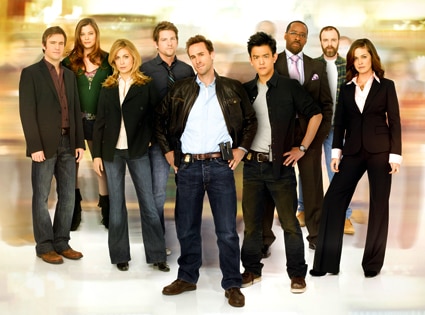
WITH: Joseph Fiennes (Mark Benford), John Cho (Demetri Noh), Jack Davenport (Lloyd Simcoe), Zachary Knighton (Bryce Varley), Peyton List (Nicole Kirby), Dominic Monaghan (Simon), Brían F. O’Byrne (Aaron Stark), Courtney B. Vance (Stanford Wedeck), Sonya Walger (Olivia Benford) and Christine Woods (Janis Hawk).
Source: NY TIMES
Microsoft has scored an elaborate multiplatform ad buy from ABC, which is promoting its upcoming sci-fi series FlashForward with a major assist from the software giant’s company’s video game assets.
The digital ad blitz, which sources said is valued at several million dollars, kicks into high gear this week with a wide array of ad placements on Microsoft’s Web, mobile and gaming platforms. The full first act of the FlashForward pilot has been available since Sept. 10 on Xbox Live—the online subscription platform where 20 million Xbox owners congregate, download movies and TV shows, and play online games.
On the series’ premiere date (Sept. 24) Microsoft’s in-game ad group Massive will serve Flash ads within 12 Xbox video games, including the mega hits Guitar Hero 5, Madden 10 and Tiger Woods PGA Tour 10.
Also that day, ABC will have a major presence on the MSN portal that includes a homepage takeover ad on MSN.com, a branded Flash site on MSN TV and ad placements that will envelop the content on MSN’s celebrity channel Wonderwall. In addition, Microsoft has built ABC a custom mobile site to promote the show, and will also run ads on its mobile portal.
Plus, users can sign up to receive text alerts prior to the premiere and can download Flash-themed phone wallpaper.
The multifaceted campaign is said to make up the bulk of ABC’s digital effort to tout the much-hyped Flash. The deal—stewarded by ABC’s agency Wieden+Kennedy—marks the second major win for Microsoft, which landed a similar buy for Discovery’s Deadliest Catch in April.
Keith Lorizio, vp of U.S. sales, Microsoft Advertising, said the company’s ability to deliver young male gamers who are likely to be drawn to the sci-fi show, was crucial. “We have a multi-screen user experience, and we have scale on all three. Xbox is absolutely a differentiator.”
Mike Benson, executive vp, marketing, ABC Entertainment Group, said ABC typically expects 3-5 percent of users exposed to a promotional campaign online for a new show will actually tune in. Given the young male audience of the Xbox, they are shooting for 10-15 percent. “As we all know, audiences have become incredibly fragmented,” said Benson. “For a show like Flash Forward…We actually think that with Xbox, we’ll get a deeper, more engaged audience that will spend a lot of time with it.”
Source: MediaWeek
Disney's freshman drama "FlashForward" has been picked up by 10 broadcasters in the Asia Pacific region, covering some 40 countries.
The series toplining Joseph Fiennes and John Cho was acquired by terrestrial broadcasters Seven (Australia), TVB (Hong Kong), Media Prima (Malaysia), TVNZ (New Zealand), MediaCorp. (Singapore), ABS-CBN (Philippines) and by payboxes Fox International Channels (covering Southeat Asia, Hong Kong and Taiwan), Zee Cafe (India), OCN (Korea) and Singtel (Singapore).
The series premieres in the U.S. on Sept. 24 on ABC.
In keeping with major U.S. suppliers' recent moves to time the launch of their shows abroad as close to U.S. debut as possible, Disney is working with Seven Down Under to facilitate launch there on Sept. 28 and with MediaCorp. in Singapore to go to air Oct. 4.
In addition, Fox International Channels will begin beaming "FlashForward" on dates staggered around Taiwan and all SE Asian markets, launching first in the Philippines on Star World (Dec. 10).
A catch-up TV service for "FlashForward" within 12 hours of the local telecast will be available in Oz and in Singapore as part of a strategy to ensure the widest audience possible.
No word on the pricing for the series was available, though top-tier U.S. dramas can rake in as much as $1 million per episode from all their terrestrial and pay TV deals combined. Racking up so many deals ahead of U.S. launch -- and ahead of the MIPCOM program sales bazaar in Cannes Oct. 5-9 -- suggests that the show has momentum and is getting decent license fees.
Rob Gilby, senior vp and managing director of Disney's TV unit in the Asia Pacific region, described the series, not surprisingly, as "the buzz show of the new U.S. TV season": "With the show's global themes and relatable characters, our partners have been aggressively marketing 'FlashForward' as a key show in their programming schedule."
To reinforce the importance of the overseas market for "FlashForward," Jessika Borsiczky, one of the executive producers of the show, will be on hand at MIPCOM to talk to other prospective buyers about the plans for the show's evolving story lines.
Earlier in the week, Disney announced deals for the show with free and pay TV broadcasters in 12 territories across Europe and the Middle East.
Source: Hollywood Reporter

”I’m just waiting to see how he cracks and if he will crack. He’s got a lot on his shoulders. That’s the downside of the flash forward. He thinks he’s onto it but maybe he’s completely wrong.”

”It’s not good. But I’m used to fearing for my future as an actor.”

”It’s ambitious and attempting to be something big. There’s a slight pressure with that. But I think it stands alone as its own.”

”I think sci-fi people are, if anything, going to be disappointed by the lack [of sci-fi]. It’s really really human, aside from the one major event. I’ve always been interested in how human beings deal with each other in a crisis, from a global crisis to a personal crisis. That’s really brought to the fore in this show.”
Source: EW
"FlashForward," ABC's new drama built upon a simultaneous mass blackout of humanity, has already spawned predictions about its inevitable success and even drawn comparisons to "Lost."
To David S. Goyer and Marc Guggenheim, creator and executive producer, respectively, the friendly buzz has created a definite upside -- and a downside. As the producers of other once highly touted, would-be hits like "Studio 60 on the Sunset Strip," "The Nine" or "Pushing Daisies" can attest, heavy expectations can overwhelm and crush a budding show.
"Actually, it's a triple-edged sword," said Goyer, whose writing credits include "Batman Begins" and its sequel, "The Dark Knight," as well as the popular "Blade" films that featured Wesley Snipes as a heroic, haunted half-vampire. "On one hand, it's great because people are seeing the value of a big-scope show like this ... [but] it's always easier to be the underdog than the heir apparent."
Added Guggenheim, who wrote "X-Men Origins: Wolverine" and was a key producer on several television series, including "Eli Stone," "Brothers & Sisters" and "CSI: Miami": "The buzz is so great, we think, 'What do the numbers have to be to satisfy the expectations?' The bottom line is, all we can do is create a show we would want to watch."
Like that of "Lost," the premise of "FlashForward," premiering Thursday at 8 p.m., is fantastically surreal, but has enough grounding in the real world to be taken seriously. On a seemingly normal day -- Oct. 6, 2009 at 11 a.m. Pacific time -- everyone around the globe suddenly loses consciousness for 2 minutes 17 seconds. During this state, people see glimpses of their own future -- April 29, 2010, at 10 p.m. Pacific time, to be exact.
As the show unfolds, people begin to chronicle their "flash forward" visions, which are then posted on the Web and become known as the Mosaic Collective. For some, the visions are comforting. For others, they are deeply disturbing. And some don't see anything at all, which is particularly unnerving. (Meanwhile, the main characters begin to ponder their destiny, whether it can be changed -- and what consequences changing a destiny might have.)
In attracting the new season's spotlight, Goyer and Guggenheim face a situation similar to one confronted last year by J.J. Abrams and other producers of Fox's "Fringe." While many thought that the supernatural-tinged thriller would be an instant hit, the series, while attracting a loyal audience, fell far short of blockbuster status. On the other hand, CBS' "The Mentalist," which launched without much fanfare, became the season's top new hit.
If the "FlashForward" producers are stressed out about the challenging road ahead, they weren't showing it during a recent lunch at Burbank-based Walt Disney Studios, where the show is filmed. The shorter, tattooed Goyer and the taller, more strait-laced Guggenheim expressed confidence in their project, and interacted like old friends even though they had never met before they teamed on the series.
In the show's production office, hidden from most others working on the show, is a large chart mapping out developments and stories for the first season . . . and beyond. Said Goyer: "There's stuff only Marc and I know. No one else."
The expectations aren't the only outsized thing about "FlashForward." The large multicultural cast combines film stars (Joseph Fiennes from "Shakespeare in Love," John Cho from the latest "Star Trek"), with TV veterans (Courtney B. Vance from "Law & Order: Criminal Intent" and Dominic Monaghan from "Lost"). The series films on one of the most massive sets on the Disney lot (the movies "Pearl Harbor" and "Pirates of the Caribbean" were also shot on the set).
Much of the buzz surrounding the pilot can be traced to a climactic twist that sets up future episodes (don't worry, no spoilers here). But Goyer and Guggenheim say "FlashForward" is much more than clever turns and gimmicks.
"If people are only tuning in for what caused the blackout," Goyer said, "then we've failed."
Unlike "Lost," where mysteries are often answered with even more elaborate mysteries, the producers of "FlashForward" promise to provide clarity -- and some answers early in the season. What they hope to set up in subsequent episodes is a wide arena in which to explore a predicament felt across all cultures -- the pull and power of destiny.
"Everyone has seen a glimpse of their future, and they can either fight it or confront it," Goyer said. "That's the theme of the show."
Source: LA Times

In the Pulitzer Prize-winning play "August: Osage County," currently being performed in L.A., one of the characters cracks no one would get out of bed if he knew what the future held.
In ABC's "FlashForward," which debuts Thursday at 8 p.m., the whole planet knows where they are going to be six months ahead of time: on April 29, 2010, to be precise.
The premise of one of the most anticipated new fall series is that everyone in the world has blacked out for two-minute and 17-seconds and has had a vision - a flash forward - to the same time six months ahead.
The visions mean different things to each person - one character about to get married sees nothing while another on the verge of suicide sees himself alive. But for them all, the question is: Are the visions inevitably true?
"We've basically broken our series regulars down into three categories," said executive producer David Goyer, whose writing credits include "Batman Begins" and "The Dark Knight."
"A third of them fear the future, and they are trying to do everything they can to fight it. A third of them, their futures are aspirational, and they are trying to do everything they can to make it happen. And a third of them are kind of agnostic because they just don't understand what it means, and they are trying to figure it out."
"FlashForward" stars Joseph Fiennes ("Shakespeare in Love") as an FBI agent Mark Benford, whose vision of the future had him looking at a
bulletin board filled with clues about the unexplained disturbance; that makes him the right man to investigate the phenomenon.Joining him on the team are two other agents played by John Cho (Demetri Noh) and Christine Woods (Janis Hawk) with Courtney B. Vance as their boss, Stan Wedeck.
Gabrielle Union is Noh's fiancee and a criminal defense attorney. Also on the series are two former "Lost" actors - Dominic Monaghan and Sonya Walger, who plays Benford's surgeon wife, Olivia, who has a vision of herself with another man.
With a large ensemble cast - 11 series regulars and numerous guest stars planned - the series opens the door (make that doors) to numerous story possibilities, both forward and back. It also opens the door to comparisons to "Lost"; the network is hoping that fans of the hit ABC's Emmy-winning series will get hooked on "FlashForward" as well.
"The primary reason why we're on ABC is I'm an enormous, enormous fan of `Lost,"' Goyer said. "I just thought it was such a genre-breaking, bold show, and it proved to me ... that you can do a show with a large ensemble cast ... tell a big, kind of cinematic story. `Lost' traffics a lot in shades of gray, different shades of morality, which is something I find really interesting."
While Monaghan sees similarities in the two shows - large ensemble casts, very ambitious storylines - he sees distinct differences at the same time.
"I don't think necessarily we're dealing with something as deeply rooted in a mythology that needs to be solved. I think this is a show that is, not necessarily to use the word "simplistic," but is probably not as sophisticated in that deeply rich mythology as `Lost' is."
"FlashFoward" is based on the Robert Sawyer novel of the same name that was in the works before "Lost" and producers are hoping that viewers will find it easier follow.
"As a viewer, I really like to feel that the storytellers know where they're going," Goyer said. "We constantly talk about the obligation we have towards our viewers to really figure it out and know where we're going."
For Fiennes, he's happy for the "opportunity to get off a horse, out of a flouncy shirt" and play "a guy that wears a gun on his hip and some cuffs on the back of his belt," referring to all the period films he's done in his career. The British actor is also excited by the complexities of the script.
"I love the idea that (the characters) contradict themselves," Fiennes said. "There's this impending doom. They seem to judge each other before these dates arrive. There's no absolute - it's not set in stone."
The London-born Walger adds that it's "utterly compelling to play somebody who thinks of herself one way ... and then to have that undone by a vision of yourself being the unfaithful one in the family home."
Goyer says the producers made a decision early on not to tell the actors a lot about where their characters are going because they didn't want it to affect their performances.
"Hitchcock used to do that with a lot of the actors he'd work with, you know," he said. "In `Shadow of a Doubt' ... he'd tells Joseph Cotten, `Just go look out the window.' And Cotten had no idea what he was looking at, but you would look at him in the movie, and it's amazing. That was sort of the pact we made."
One thing we know is that April 29, 2010, is not the end of the show - at least if it's a big enough of a hit.
Producers say they've loosely plotted out five seasons, and won't say what the significance of the spring date is, only that it's "one of the mysteries of the show."
April 29th happens to be a Thursday night; so Fiennes says it's no mystery as to what he'll be doing - "tuning in."
Source : Pasadena Star News
‘If you saw a glimpse of your future, what would you do?” asks David Goyer, executive producer of ABC’s FlashForward.
Well, if you’re on “Flash Forward,” you might end up dead. What lies ahead is the central question of this tantalizing new series, based on the novel by Robert J. Sawyer.
In the first episode, the human race blacks out for two minutes and 17 seconds. Chaos reigns as planes, trains and automobiles remain perilously in motion. FBI agents Mark Benford (Joseph Fiennes) and Demetri Noh (John Cho) wake up from their respective blackouts in the middle of a grim crash scene in downtown Los Angeles. A motorcycle is pinned under an overturned car. A corpse lies face-up on the asphalt.
 ABCJoseph Fiennes and John Cho on location in downtown Los Angeles.
Benford and Noh immediately go into rescue mode, but they’re still confused about what they’ve seen. During the blackout, everyone sees exactly where they will be in six months. As a result of his vision, Benford realizes he will play a central role in figuring out why the flash forward happened. While Benford initiates his investigation — and wrestles with personal demons — others spend their time trying to avoid the future.
“It’s the kind of thing that could get sci-fi and weird very quickly,” says Sonya Walger, who plays Olivia Benford, Mark’s wife, a surgeon. “But [the producers] are so smart to have this one convulsive electric shock that happens globally. After that, it’s just human responses to that event. It’s like 9/11 to the power of one million.”
The long-married Olivia flashes forward to see herself with another man, whom we meet at the end of the episode.
“Olivia is working hard to not bring about her future, because her future is the end of her marriage,” says Walger. “At the end of the pilot, she tells her husband what she’s seen. I found that fascinating. We’re so used to seeing women lie to their husbands on TV.”
“Flash Forward” has been compared to ABC’s sci-fi hit, “Lost,” on which Walger also stars, but the two shows differ structurally and dramatically.
“What ‘Lost’ does with its flash forwards is something narrative,” says Goyer. “In our world, it’s literal. The people literally flash forward.”
“What’s difficult is for us to make sure that we’re being consistent in the way this world operates,” says Marc Guggenheim, another executive producer on the show. “We have to remember, ‘Oh yeah, that character can’t do that now because we have to put him in China in six months.’ ”
To track their stories, the show producers have what Goyer calls a “massive meta board,” that measures 30 feet long and 10 feet high.
“It charts every series regular and every recurring character across every episode and it charts the theme of every episode. It’s like the war room at the Pentagon,” he says.
“We planted some very bold flags in the pilot,” Goyer explains. “By the end of the first season, we’re going to see whether these specific futures come true. We’ll catch up to that date we’ve flash-forwarded to. We really can’t tread water for that long.”
In fact, Goyer and Guggenheim say they have mapped out not only the entire season, but the entire show.
“I don’t think there’s ever been a network show that’s been this planned out, except maybe ‘Babylon 5,’ ” says Guggenheim. “I was a huge fan of that series. I was always impressed by the level of obvious planning that had been put in. In our show, the proof is in the pudding — you can see it in the elegance of the way the story pans out.
“We’re doing it in a way that people will find unexpected. Unlike a show with a mystery at its core, we’re providing answers a lot sooner than other shows of this kind have done in the past.”
Source: NYPOST
BURBANK, Calif.—Writers on the new television series "FlashForward" work in a room with the window blinds drawn tight. They don't want to risk anyone peeking into their office on the sunny Walt Disney Studios lot here.
A drama about a blackout that gives the entire human population a quick glimpse six months into the future, "FlashForward" debuts on ABC on Thursday. The main characters try to figure out what caused the blackout while some attempt to avert their own vision of the future. ABC has bet big on the show from David S. Goyer, co-writer of the "Batman Begins" and "The Dark Knight" movies, and starring British actor Joseph Fiennes.
ABCJohn Cho and Joseph Fiennes, who play FBI agents Demetri Noh and Mark Benford, in the premiere of ‘FlashForward.’
The program uses one of the oldest dramatic techniques and attempts to stretch it to new heights—the cliffhanger. The show's goal is to leave the audience in suspense at the end of each episode and even before almost every commercial break.
Television cliffhangers are rare these days. In recent years, networks have been reluctant to launch shows with narratives that stretch from one episode to the next. Such programs don't bring in as much revenue in reruns as shows like "Law & Order" and "CSI" that wrap up neatly in an hour. Serialized episodes must run in sequence, making a lucrative syndication deal less likely, network executive say. Plus, they're more expensive to produce, with large ensemble casts and on-location shoots.
"FlashForward" aims to join a small group of hit serials like ABC's "Lost" about plane-crash survivors stranded on a mysterious island and Fox's "24" about a day in the life of counterterrorism agent Jack Bauer, played by Kiefer Sutherland. "24" became one of Fox's biggest hits when it premiered in 2001. ABC hopes "FlashForward" can replace "Lost," which begins its sixth and final season early next year. The eighth season of "24" starts in January.
Required Reading
Executive producer David Goyer requires "Flash Forward" writers to read everything from Japanese poetry to Austrian philosophy. Here's a selection of the books that shape their vision of the show:
![[SiddharthaBook]](https://lh3.googleusercontent.com/blogger_img_proxy/AEn0k_svr3g1xhZwa3XS4rvxHdhpdvT9DuVvqqS0hf-nUuqvtvMxqAkC7q3x_D4cQqLapuIpo-avvMi_2BOBz4HUFaHfsB3Rc4buhjUJ7r2w6tkfHretZWw5HdjMG0oxlxVz_RK8Gs0AdO3xEqigx2SvHSKZFg=s0-d)
- "Labyrinths" by Jorge Luis Borges
- "The Road Not Taken" by Robert Frost
- "Siddhartha" by Herman Hesse
- "The World As Will and Representation" by Arthur Schopenhauer
- "The Tale of Attaf from the Arabian Nights"
- "The Myth of Oedipus"
- "Japanese Death Poems" by Yoel Hoffman
- "Philosophical Investigations" by Ludwig Wittgenstein
- "The Dancing Wu Li Masters" by Gary Zukav
These programs attract a dream television audience, says Stephen McPherson, ABC's president of entertainment. Intensely loyal fans discuss the series online, buy DVD box sets and tend to watch episodes in real time since they want to find out what happens next as soon as possible. "These shows lend themselves to a very different kind of extended experience," Mr. McPherson says.
Cliffhangers have become more intricate in response to the growing sophistication of audiences who have seen so many over the years. Also, viewers can record and replay episodes to search for clues or discrepancies. A proliferation of Web sites that publish spoilers can ruin endings by posting them before they air.
It's the "seat-belt conundrum," says Damon Lindelof, co-creator and executive producer of "Lost." Sophisticated audiences would roll their eyes at a character driving over a cliff as he tries to unbuckle his seat belt, Mr. Lindelof says.
To guard plot secrets, each "FlashForward" script has a made-up title and is watermarked so that if a page gets into the wrong hands producers can trace it to the source. Actors, cast members and producers are referred to by code names that can change weekly. (Mr. Goyer went by "John Lennon" this summer.) At casting sessions for extras, aspiring actors can end up reading fake dialogue or auditioning for roles that don't exist. Actors receive directions to on-location shots as late as midnight the night before. Temporary street signs to help cast members find the shoot use fake titles, a strategy that has led to some actors getting lost.
Other shows have used an array of tricks. "Lost" producers shot three versions of a scene in which plane crash survivor John Locke lies in a coffin. They didn't drop the shot into the finished episode until the last minute. They code name some scenes with Jewish bread. "The Bagel" was a scene in season one where 10-year-old crash survivor Walt Lloyd is abducted. The second season finale was "The Challah."
Hollywood is full of tales of scripts leaking out. Howard Gordon, an executive producer of "24," says fans rifled through the trash at an old pencil factory in Chatsworth, Calif., where "24" is shot, looking for scripts. They found a handful of pages and posted plot secrets online. Someone stole a "daily," or a version of the script handed out on set on each shoot, out of a "Lost" producer's mailbox. It ended up online, too.
If a secret gets out, producers try and manipulate the information to create confusion and suspense. The "FlashForward" creators have set up a Web site called Truth Hack, which includes the work of fictional journalist Oscar Obregon, who is investigating the world-wide blackout. His posts provide clues, and plenty of misinformation.
Showing Suspense
Some current and recent television series that teased, and won, viewers.
![[CliffHang_D]](https://lh3.googleusercontent.com/blogger_img_proxy/AEn0k_tyxUjSwrJPX4YQQ2eWSg3-3vJ8ThG6W7KIcfoZEGo75qDBeF8GsFdnTRwrs1qEiCD11jThP1_YNZ4ipkot6sH2bKUcq68sHlZYSDghBEpO2N8Q3RIlIaQHy08DMeKTlQBYt3UpLbimhLrolh_4zeSi=s0-d)
"FlashForward" actors typically do not know what will happen more than a couple episodes in advance. Actor John Cho, who plays FBI agent Demetri Noh, says he regularly corners writers to ask if he is the evil mastermind, a popular theory on fan blogs. Mr. Fiennes says he feels like a "junkie knocking on the production door to ask what will happen."
It is tougher today to pull off an iconic TV cliffhanger like the 1980 "Who Shot J.R.?" episode of hit drama "Dallas." Actor Larry Hagman, who played oil baron J.R. Ewing, says fans offered him $150,000 to reveal who shot his character. Unfortunately, the writers kept it a secret from him until a couple of days before the revelatory episode was shot. "I was willing to sell the information," he said in an interview. "That's what J.R. would've done."
"Dallas" creator David Jacobs says the surprise ending came about by accident. At the last minute, CBS ordered an additional four episodes of the show which meant the writers had to quickly come up with a way to stretch the storyline without losing viewers, he says. "The writers just looked at each other and someone said, 'Let's shoot the son of a bitch.' "
Cliffhangers became popular in the 1920s in silent short films that ran in installments before a feature-length movie started and often ended with the hero tied to train tracks or literally hanging from a cliff. The term first appeared in the late 1930s and referred to melodramas that left characters in physical peril.
Television Classics
From Hitchcock to a snow globe, some moments that left viewers wondering.
Everett Collection
Alfred Hitchcock Presents
1955-65
After directing films for three decades, Alfred Hitchcock applied the same suspense and twisted endings to this series which he hosted. Evil often prevailed in the end, a revolutionary shift in the traditional TV landscape.
Everett Collection
The Fugitive
1963-67
Accused of killing his wife, Dr. Richard Kimble flees Lt. Philip Gerard and searches for the one-armed man who he believes committed the murder in this nail-biting series that marked one of the first times a serialized TV drama ended each episode with a cliffhanger.
Everett Collection
Dallas
1978-91
The 1979-80 season finale became a moment in television history. An unseen gunman shoots oil baron J.R. Ewing, who is rushed to the hospital in critical condition. At the start of the next season, 83 million people tuned in to find out "Who shot J.R.?"
Aaron Spelling Prod./Everett Collection
Dynasty
1981-89
With almost every main character at the wedding of Amanda Carrington and Prince Michael of Moldavia, a military coup breaks out. Revolutionaries open fire, leaving about 60 million viewers wondering until the next season who survived.
NBC/Photofest
St. Elsewhere
1982-88
In one of the most talked-about cliffhanger resolutions, Tommy Westphall plays with a snow globe in the series finale. Inside, viewers see a replica of the St. Eligius hospital where the show takes place, leading them to believe the entire series took place in Tommy's mind.
Paramount/Everett Collection.
Star Trek: The Next Generation
1987-94
Trekkies held their collective breath in the third season when Patrick Stewart's Captain Jean-Luc Picard was captured and turned into a member of a fictional race of cybernetic organisms or cyborgs.
The cliffhanger was a natural fit for TV shows trying to get viewers to return each week. "In a movie, the audience is already captive and you don't have to vie for their attention to keep coming back," says Glenn Kessler, co-creator and an executive producer on FX's drama "Damages."
Almost every cliffhanger fits into one of three basic categories: a character is in jeopardy, a character does something unexpected, or something shocking is revealed. Mr. Gordon, the "24" producer, says he favors cliffhangers that reverse preconceived notions. In the show's first season, for example, Jack's wife, Teri Bauer, believes she is searching for her teenage daughter with another concerned parent. The man turns out to be a kidnapper impersonating a suburban dad. The writers dreamed up the cliffhanger and then wrote the story to lead to its crescendo. "We try to find the last possible thing that can happen, the most surprising thing that can happen and then we retrofit the story around that," Mr. Gordon says.
Serialized shows are increasingly taking advantage of changes in how viewers watch television, namely that more viewers record episodes, network executives say. By 2014 as many as 42% of all U.S. homes with a television are expected to record programs, up from 26% in 2008, according to forecasts by Magna, a unit of IPG Mediabrands.
"Battlestar Gallactica," a critically acclaimed but low-rated series that aired on NBC Universal's SyFy channel until it ended last March, used DVD sales to fuel its following and released a special-edition DVD just days after one broadcast. "You-gasp-and-you-tremble-and-you-reach-for-the-next-disc is just as good as you-gasp-and-you-tremble-and-you-wait" for the next episode, says co-executive producer Jane Espenson.
Shows like "Damages," "Lost" and "24" drop clues, or "Easter eggs," as TV writers call them, into episodes that flash on screen for mere seconds. Writers say they know fans will record shows and watch again to hunt for clues.
In the first episode of "FlashForward," a kangaroo hops across the wreckage on a Los Angeles street. The kangaroo is a clue that will return in upcoming episodes, the writers say. The writers also stick clues in props that viewers who pause scenes can spot. "FlashForward" features a giant, messy bulletin board in the office of Mr. Fiennes's character, FBI agent Mark Benford. In the first episode, Mark posts a card on it that says "D. Gibbons." D. Gibbons is a shady character not fully revealed until the 18th episode, writers say. A version of the board hangs in the writers' room to help them track clues.
Mr. Goyer, who wrote comic books as well as movies, and his wife, Jessika Borsiczky Goyer, began talking about turning Robert J. Sawyer's 1999 novel "Flashforward" into a television show eight years ago. HBO helped them develop the series but dropped it before production began. A spokeswoman for HBO says the cable channel decided "FlashForward" would be a better fit on a broadcast network. ABC picked up the project.
Cliffhangers require writers to work farther in advance than typical television shows. They plot out the narrative arc of an entire season to set up the suspense and then resolve it, Mr. Goyer says. Changes may come up as long as the momentum continues to build to the overarching cliffhanger that takes viewers into the next season. They completed seven scripts before shooting started on "FlashForward" in July.
On a hot August afternoon, nine writers on "FlashForward" sat around a small conference table with a pile of highlighters and colored pens to write an episode that wouldn't run until the winter. The walls of the room were covered in dry-erase and corkboards with index cards color coded to correspond to the show's 10 series regulars. The cards are filled with scribbling of character attributes like "self doubt," or plot developments like "goes to kitchen" and "bored, drinking, masked killer."
They needed to write a cliffhanger ending for episode 10, which isn't slated to run until December—right before a three-week break for the winter holidays. "If we're going to be off the air for that long, we want to build up and have a lot of very dramatic stuff happen in this episode," co-creator and executive producer Mr. Goyer said.
It would call for top-secret plot developments. Those are posted on a corkboard hanging in the writers' room that Mr. Goyer calls "the megaboard." At night it is shuttered behind another board and locked.
SOURCE: Wall Street Journal


![[CliffHang_D]](http://online.wsj.com/public/resources/documents/info-enlargePic07.html?project=imageShell07&bigImage=wsj_CliffHang2091709.jpg&h=690&w=1066&title=WSJ.COM&thePubDate=20080826)
Premiere: Thursday, Sept. 24, 8-9 p.m.
Competition: Survivor: Samoa, The Vampire Diaries, Bones, Parks & Recreation
Cast: Dominic Monaghan, John Cho, Joseph Fiennes, Sonya Walger, Courtney B. Vance, Gabrielle Union
Status: We've seen the first episode.
Should you watch FlashForward? Read on...
Where were you on April 29, 2010? Maybe you can't remember your future, but the characters on ABC's enigmatic new series glimpse theirs when they black out for two minutes and 17 seconds. After awakening to the chaos—freeway collisions, plane crashes, rogue kangaroos—resulting from this "global event," they must confront how their "flashforward" visions will influence how they act in the present.
Comparisons to Lost (also on ABC) are inevitable—FlashForward is a time-bending, mythology-oriented story told from the perspectives of individual characters in a huge ensemble cast—but both are exceptionally unique. Maybe it's more accurate to call Lost the wingman for FlashForward. If it weren't for Lost's success, ABC probably would not be as committed—financially and creatively—to this new epic series.
But the network has invested in the cinematic visions of show runners David Goyer and Marc Guggenheim (the creative forces behind Batman Begins, The Dark Knight, X-Men Origins: Wolverine and The Green Lantern). Blockbuster movie stars like Joseph Fiennes, Dominic Monaghan and John Cho are equally inspired by the ambitious concept—which, Goyer revealed to us, just "gets bigger and bigger and bigger."
As Fiennes (who stars as FBI Special Agent Mark Benford) says, "It stirs up a great conversation about predestination...if you could see a future that wasn't so beautiful, would you want to avoid it? Would you want to change it?"
"Those who change their futures," he added ominously, "do so at their peril."
Verdict: Watch (and DVR for Easter eggs)
Source: E Online

By Bill Keveney, USA TODAYBURBANK, Calif. — The FBI agent and his wife's apparent future lover just miss crossing paths in the hospital hallway. They don't meet, but what if they had?Would it block his wife's path to infidelity? Or would it guarantee it?
The underlying question — can you change your future? — is at the heart of ABC's FlashForward (Sept. 24, 8 ET/PT), among the most-awaited new fall TV series, and one that some are calling the next Lost.
The premise centers on a two-minute, 17-second blackout that strikes the world's population, followed by crashes, deaths and other disasters that result from the global unconsciousness. During the blackout, almost everyone has a vision — a flash-forward — six months ahead, to April 29, 2010. 10 p.m. PT, to be exact. Some are welcome, and some, including the wife's vision of the lover, are not.
The task is to find out what happened and if the flash-forward prophecies will, or must, come to pass.
"We are the only species that thinks about the future," says executive producer David Goyer, whose writing credits include Batman Begins and The Dark Knight. "It's the blessing and curse of being human."
Joseph Fiennes, who plays FBI agent Mark Benford, centers a team assigned to solve the blackout that includes partner Demetri Noh (John Cho); colleague Janis Hawk (Christine Woods); and their boss, Stanford Wedeck (Courtney B. Vance). They and the other characters, including Benford's surgeon wife, Olivia (Sonya Walger), share their visions, but viewers see only bits and pieces at first, leaving twists and turns to be explored.
And "some people lie about their flash-forwards, so it's a little misdirection happening," Vance says. "It leaves the writers enormous latitude to tell stories."
Of fall's new shows, FlashForward most closely fits the definition of the serialized epic, a sweeping tale mixing action, suspense, mystery, romance and melodrama. "It's a buffet," executive producer Marc Guggenheim (Eli Stone) says. "To reach the widest audience possible, you need to have that spice. You have to have that wide variety."
The best current example of the big, bold serialized mystery: ABC hit Lost. Fox's 24 incorporates many of those elements, though each season is self-contained. Fox's paranormal Fringe tries to temper its serialized elements, mixing long-term story with shorter, weekly ones. And ABC launches a remake of alien-invasion serial V in November.
The challenging format tends to demand more dedication from viewers, who may not want to make the time commitment, especially when there is no guarantee a show will reach its conclusion. It includes many recent failures, some of them noble, such as The Nine and Jericho, and even critically acclaimed successes Lost and 24 have hit bumps. NBC's Heroes, which tries to balance serialization with stand-alone volumes, was a big early hit but has since slumped.
Quick answers to questions
Goyer and Guggenheim say they are making the show as they want to, but their customized format — many character stories that wrap up in one episode, quick answers to major questions and a simplified but not dumbed-down mythology — also may make it appeal to a broader audience and casual viewers. "It's not that kind of show where if you don't catch it at the beginning you'll be lost," Vance says.
At the same time, more devoted fans will be rewarded with numerous little clues and hidden references. "You'll come across the true genius that is David Goyer, which is these Easter eggs," Fiennes says. "There's so much information that you could certainly go crazy trying to work it all out."
As another viewing incentive, Goyer promises to resolve virtually all questions raised in the pilot by this season's end. "We made the commitment very early on to answer some big questions and have some reveals very early. The audience will be surprised at some of the cards we turn over that early."
ABC has an interest in series that are "something epic in scope but also really emotional," network executive vice president Suzanne Patmore-Gibbs says. Characters must be at the core, she says, whether the serialized program is Lost,Grey's Anatomyor FlashForward.
Goyer likes mixing large and small. "One of the things I like to do is take a big, broad subject matter and see if you can work it through this intimate prism with characters who humanize what would normally be what some would call an E-ticket ride. I think we were able to do that with the Batman movies, and I feel that's what we're doing here."
He and Guggenheim are Lost fans, citing the Emmy-winning hit's groundbreaking nature as one reason they thought ABC would be a good place for their series. ABC hopes Lost fans connect with FlashForward.
"Lost is ending this year and hopefully going out with a bang. There's an audience base that's going to be craving another nuanced experience, and it would be nice to win some of those audience members," Patmore-Gibbs says. But she and others point out large differences between Lost and FlashForward, which was inspired by Robert Sawyer's novel of the same name and in planning before Lost was created. (The TV series veers far from the book, producers say.)
"It's not like we're going to unearth layers and layers that are more sci-fi or layers and layers of mythology. So I think it's easier to access in some ways," Patmore-Gibbs says.
Walger, who has had a recurring role on Lost, considers it "a huge compliment being (mentioned) in the same breath as Lost. (But) I think the similarity begins and ends with big ensemble casts."
FlashForward has a large, diverse ensemble — 11 series regulars, including Lost's Dominic Monaghan, and guest stars from around the world — that opens the door to many individual stories, both professional and personal. To be a TV series rather than a movie, FlashForward had to be about more than blackouts and flash-forwards, says Cho, who also visited the future in this year's Star Trek film.
"We couldn't hang our hats on that big concept. It had to be about relationships and how it affected everyone's lives. That, to me, was the hook," he says.
On the largest soundstage on the Disney studios lot, one usually reserved for feature films, some character stories — and bits of police and medical drama — are intersecting at Olivia's hospital when Mark and his FBI colleagues arrive. She has just saved a series regular who was injured in an attack resulting from their investigation.
"Mark has this guilt, but at the same time he feels vindicated that the clues are paying off," Fiennes says.
The 'what-if?' element
Of FlashForward's many elements, those involved with the series say science fiction may be the least. It also happens to be a genre label that turns off some viewers who might otherwise give a series or movie a try.
The show's science-fiction component is limited to the blackout and flash-forwards, if that, the producers say, with Goyer suggesting the ultimate cause may not even be in the realm of that genre. He describes the look forward as a "what if?" rather than science fiction, akin to Scrooge's glimpse of the future in A Christmas Carol.
While FlashForward's characters see bits of the future, Goyer and Guggenheim know it all, as in how the series ends.
"In a post-Lost world, when you take a pilot to the networks, they ask, 'Do you have any idea where it goes?' " Goyer says. "As a viewer, I would feel frustrated if the show creators don't know where they're going."
They have plotted the series out, a difficult task when it isn't known how long it will run. Goyer says they have loosely planned it for five seasons, could tell it in three, if necessary, or could "accordion it out" to run longer than five. Besides the ending, they say they know how the penultimate season concludes.
"They have had a destination in mind the whole time, knowing how hard it is when you don't," Patmore-Gibbs says. She notes Lost has benefited from having a fixed ending point, though no one suggested FlashForward might follow a similar plan.
The series can expand on a character or story if it breaks out in a big way. In the pilot, Benford encounters a kangaroo on a downtown L.A. street after the blackout. "It was something intended as a grace note. I didn't expect it to get quite the response it has," Goyer says. He and Guggenheim have made sure the Australian interloper will return.
"We've altered stuff along the way, as we've refined and gotten a better handle on things," Guggenheim says. "Something happens in the 11th episode of the show that had been planned for Episode 18, or even later."
But what happens after Season 1's last episode? If FlashForward answers nearly all the questions in the pilot by the season's end, what will be left for next year?
"I hope people ask that," Goyer says. "In some ways, I can't wait to get there. It's going to be more exciting than Season 1."
Source: USA Today

PASADENA, Calif. — ABC’s “Flash Forward,” a new serialized Thursday night drama, has been dubbed “the next ‘Lost,’” and there are similarities.
A large international cast tells an unfolding story that begins with a cataclysmic event: Everyone on the planet blanks out for a little more than two minutes. During that time the characters flash forward and see a few moments from t heir lives on a specific future date: 10 p.m. on April 29, 2010. Some like what they see in the future, others do not.
Is the future they see their destiny? Can they change the future? And why does a kangaroo — a stand-in for the “Lost” polar bear, perhaps? — hop down a Los Angeles street after everyone awakens? These are questions viewers will be left to wonder about after the pilot airs at 8 p.m. Sept. 24.
“By the end of the first season, most of the questions raised in the pilot … will be answered,” said executive producer David S. Goyer (”Threshold”). “The cause of why the blackout happened, that’s our background radiation mystery for the whole series.”
“Flash Forward” follows an FBI agent (Joseph Fiennes, “Shakespeare in Love”) and his partner (John Cho, “Star Trek”); the agent’s surgeon wife (Sonya Walger, “Lost”) and assorted other characters. “Lost” veteran Dominic Monaghan will have a role in “Flash Forward” beginning sometime in the first six episodes after the pilot. Details of his character, Simon, remain under wraps. He said the show is less mythology-driven than “Lost.”
Although there have been recent TV seasons with a plethora of serialized shows (”The Nine,” “Day Break,” etc.), this fall “Flash Forward” has that space largely to itself.
“We have only succeeded when we’ve been ambitious and taken chances and pushed the limits,” McPherson said, naming “Desperate Housewives” and “Lost” as past high concept successes. He emphasized the importance of a portfolio approach that mixes big shows such as “Flash Forward” with smaller projects. “For me, there’s so much great drama out there, you have got to be ambitious. You have to break through the clutter.”
SOURCE: Pittsburgh Post-Gazette
Every so often, a new TV show comes along that's so eye-filling, so visually startling and so emotionally gripping that it feels like a tectonic shift may be about to occur in the popular culture.
ABC saved the best for last, unveiling its pilot episode of the secretive, big-budget futuristic thriller FlashForward, based on the novel by Canadian Robert J. Sawyer.
In an age when broadcast TV faces across-the-board cost-cutting and scaled-down ambitions, FlashForward represents a throwback to an earlier age. Not since the pilot episode of Lost has a single hour of network TV looked -- or felt -- more like a feature film.
FlashForward, about a two-minute, 17-second blackout that affects every person on Earth, is full of suspense and unanswered questions. Based on its initial screening, though, it's also full of genuine, human emotion.
FlashForward is more than just a futuristic What If' tale. In a notably buzz-free fall season, it's a reminder of just how powerful the medium of TV can be, how it can move a mass audience to tears, laughter and excitement by turns.
FlashForward is, quite simply, the most eye-filling, heart-wrenching pilot episode of a new network drama series since Lost -- and it gives us all hope that this may not be such a bad fall TV season after all.
Source: National Post


